13 Oct, 2026
08 Jan, 2026
There was a time when employee recognition had a fixed shape.
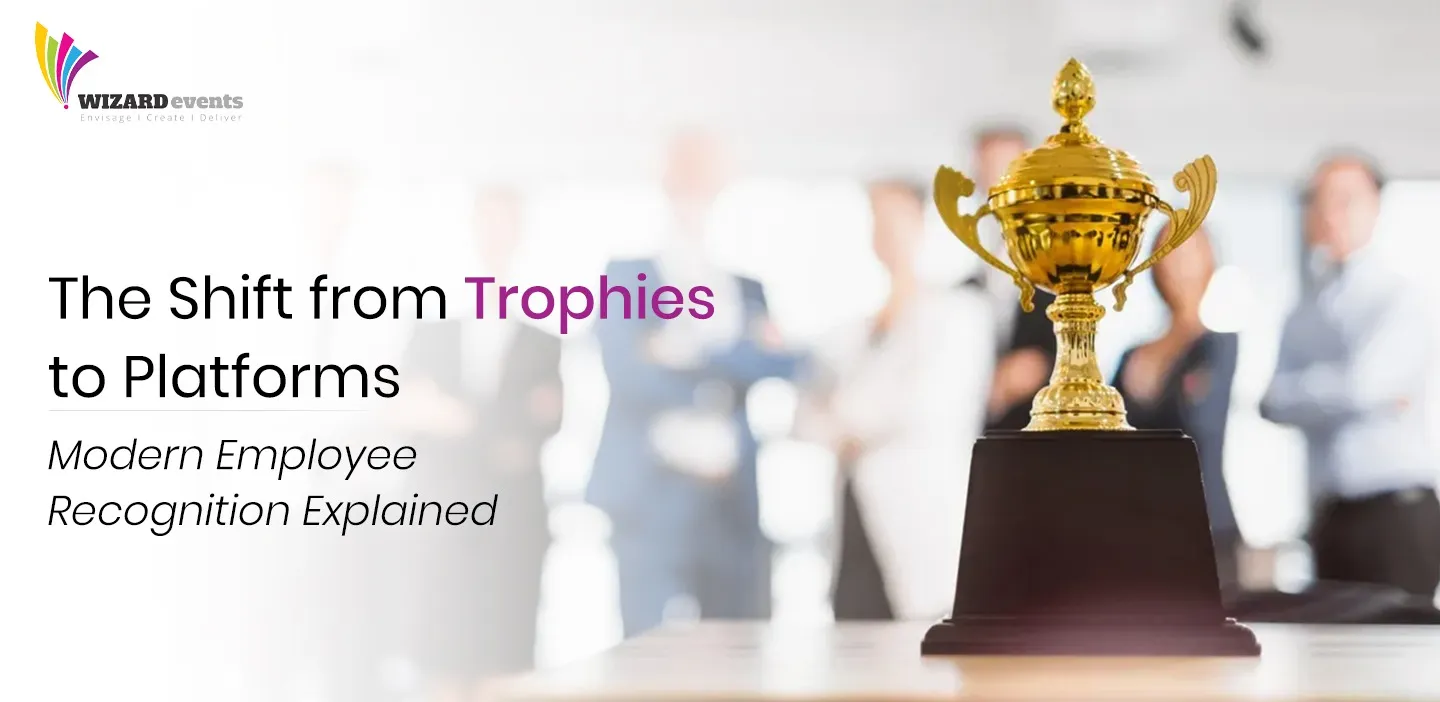
A trophy.
A certificate.
A photo with leadership that lived briefly on the intranet and permanently in a drawer.
It wasn’t meaningless. But it was limited.
By the mid-2020s, organisations began to realise something quietly important: recognition doesn’t fail because people don’t appreciate it. It fails because it doesn’t travel far enough, long enough, or often enough.
In 2026, recognition has moved away from moments and toward systems. Away from applause and toward participation. Away from trophies and toward platforms.
At Wizard Events, working at the intersection of culture, behaviour, and experience, we’ve seen this transition unfold in real time. Recognition today is no longer an HR activity. It’s an operating layer.
This blog breaks down why that shift happened, what modern recognition actually looks like, and how tech-enabled systems are reshaping the employee rewards and recognition program across India.
Why Traditional Recognition Started Falling Short
Traditional recognition relied heavily on symbolism.
Annual awards.
Stage moments.
Top-down validation.
These worked when organisations were smaller, hierarchies clearer, and work cycles slower. They struggle in today’s environment.
According to research from Gallup, only 23% of employees strongly agree that they receive meaningful recognition for good work
Reference: https://www.gallup.com/workplace/236441/employee-recognition-low.aspx
The gap isn’t appreciation. It’s frequency, relevance, and reach.
People want recognition that:
- Happens closer to the behaviour
- Feels contextual, not ceremonial
- Involves peers, not just managers
Trophies can’t scale that.
Recognition Is No Longer a Moment. It’s a System.
Modern organisations don’t ask, “How do we recognise people?”
They ask, “How does recognition move through our organisation?”
That’s a fundamentally different question.
Platforms allow recognition to:
- Be continuous instead of annual
- Be peer-driven instead of hierarchical
- Be visible without being performative
According to Deloitte, organisations with continuous recognition systems show 31% lower voluntary attrition
Reference: https://www2.deloitte.com/us/en/insights/focus/human-capital-trends.html
This is where the employee rewards and recognition program stops being an event and starts behaving like infrastructure.
Why Platforms Beat Programs
Programs have schedules.
Platforms have participation.
That distinction matters.
A program runs whether people care or not. A platform only works if people use it.
Modern reward & recognition programs for employees are built around:
- Real-time appreciation
- Social visibility
- Data-backed insights
- Behaviour reinforcement
According to a study by McKinsey & Company, employees who receive recognition through digital platforms are 2.7× more likely to be highly engaged
Reference: https://www.mckinsey.com/capabilities/people-and-organizational-performance
Engagement here isn’t emotional fluff. It translates into retention, collaboration, and discretionary effort.
Technology Didn’t Replace Human Recognition. It Amplified It.
One fear organisations had early on was that technology would make recognition impersonal.
The opposite happened.
Platforms didn’t remove emotion. They removed friction.
Recognition no longer waits for:
- Annual reviews
- Budget approvals
- Leadership presence
It happens when behaviour happens.
According to Harvard Business Review, timely recognition is significantly more effective at reinforcing behaviour than delayed acknowledgment
Reference: https://hbr.org/2022/recognition-at-work
This immediacy is what trophies never managed to deliver.
Recognition as a Driver of Loyalty, Not Just Motivation
Here’s where things get interesting.
Recognition used to be about motivation.
Today, it’s about belonging.
According to research from PwC, employees who feel consistently recognised are nearly 3× more likely to describe themselves as loyal to their organisation
Reference: https://www.pwc.com/workforce
This is why recognition now sits at the centre of the employee loyalty program, not on the sidelines.
Loyalty isn’t created by compensation alone. It’s created by visibility, fairness, and repeated acknowledgment of effort.
Platforms make that visible across teams, locations, and hierarchies.
What Modern Recognition Looks Like in Practice
In organisations that have made this shift, recognition looks different.
It’s not louder. It’s steadier.
You’ll see:
- Peers recognising peers publicly
- Managers reinforcing values through everyday actions
- Leadership using recognition data to understand culture gaps
According to Forrester, data-driven recognition platforms help organisations identify high-impact behaviours that formal KPIs often miss
Reference: https://www.forrester.com/research/
This turns recognition into insight, not just appreciation.
Where Events Still Matter in a Platform-Driven World
Here’s an important clarification.
Platforms didn’t kill events.
They changed their role.
Events now:
- Launch recognition platforms
- Reinforce cultural narratives
- Celebrate collective milestones surfaced by data
At Wizard Events, we design recognition moments that plug into systems, not sit outside them. Events become accelerators, not substitutes.
This is where experience and technology stop competing and start collaborating.
Are There Organisations in India Offering Tech-Enabled Recognition Systems?
Yes. And the ecosystem is growing rapidly.
India has seen a sharp rise in organisations adopting tech-enabled employee rewards and recognition program models, particularly in sectors with distributed teams and hybrid workforces.
According to industry adoption reports from NASSCOM, over 60% of large Indian enterprises have either implemented or are actively piloting digital recognition platforms
Reference: https://nasscom.in/
What differentiates successful implementations isn’t the software. It’s the behavioural design layered on top of it.
Why Recognition Platforms Fail When Design Is Ignored
Technology alone doesn’t fix recognition.
Without intent, platforms become:
- Quiet dashboards
- Underused tools
- Another HR system people forget
According to organisational behaviour studies published by MIT Sloan, recognition systems fail when they are not aligned with real behavioural norms and leadership actions
Reference: https://sloanreview.mit.edu/
This is why recognition design matters as much as platform selection at Wizard Events.
The Real Shift Nobody Talks About
The biggest change isn’t digital.
It’s philosophical.
Recognition has moved from:
- Scarce to abundant
- Top-down to networked
- Occasional to embedded
Trophies celebrated outcomes. Platforms reinforce behaviours.
That’s a much deeper lever.
Where Recognition Is Heading
Recognition hasn’t disappeared. It has evolved.
What organisations are realising now is that appreciation works best when it isn’t reserved for milestones but embedded into everyday work. Platforms allow recognition to move faster, reach wider teams, and reflect real behaviour rather than isolated outcomes.
Trophies still have a role, but they no longer carry the system on their own.
Modern recognition works when technology, experience, and leadership intent operate together. That shift, from symbolic moments to functional platforms, is what’s reshaping how employee recognition is being designed and delivered across organisations today.