13 Oct, 2026
05 Jan, 2026
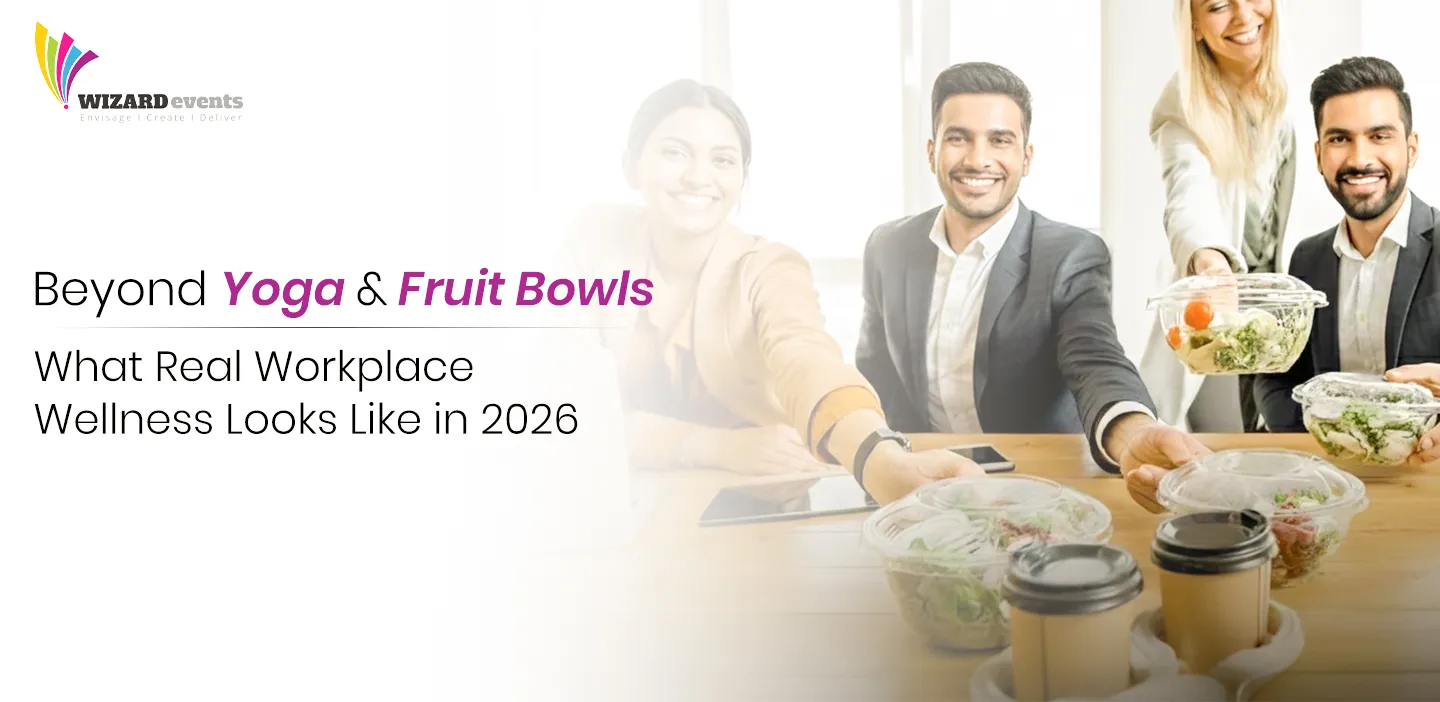
For years, workplace wellness has followed a predictable script.
A yoga instructor once a week.
Fruit bowls that run out by noon.
A poster about mental health that quietly fades into the background.
It looks considerate. It sounds progressive. It rarely changes how people actually feel at work.
By 2026, most organisations have reached an uncomfortable conclusion: wellness theatre doesn’t work. Employees aren’t exhausted because they skipped meditation. They’re exhausted because systems, behaviours, and expectations drain them daily.
At Wizard Events, working closely with leadership teams across industries, we’ve seen workplace wellness evolve from a feel-good initiative into something far more serious. As one of the event management companies in delhi operating at the intersection of culture and experience, we see wellness not as an activity, but as organisational design in action.
This is what real workplace wellness looks like now. Less performative. More structural. And far more honest.
The Problem With Traditional Wellness Programs
Most wellness programs fail for one simple reason.
They sit on top of broken systems instead of fixing them.
Employees attend a wellness session and then return to:
- Back-to-back meetings
- Unclear priorities
- Managers who reward burnout
- Cultures where rest needs justification
According to Deloitte’s Global Human Capital Trends, nearly 70% of employees say workplace wellness initiatives feel disconnected from their actual sources of stress
Reference: https://www2.deloitte.com/global/en/pages/human-capital/articles/introduction-human-capital-trends.html
That gap between intention and reality is where wellness loses credibility.
Why Workplace Wellness Feels Different After 2025
The past few years forced organisations to confront things they could previously ignore.
Hybrid work blurred boundaries.
Availability quietly replaced flexibility.
Burnout stopped being an exception and became the norm.
By 2026, leaders are recognising that wellness cannot be outsourced to HR calendars. It has to be embedded into how work is structured.
According to research by the McKinsey Health Institute, organisations that redesigned workflows alongside wellness initiatives saw a 32% improvement in employee engagement
Reference: https://www.mckinsey.com/mhi/our-insights
This is the turning point. Wellness is no longer about adding benefits. It’s about removing friction.
Wellness Has Shifted From Activities to Architecture
The most effective wellness strategies today don’t start with scheduling sessions. They start with diagnosing stress.
Where do decisions get stuck?
Where does emotional labour pile up?
Where are people expected to absorb chaos quietly?
Real wellness now focuses on:
- Meeting design and cadence
- Decision clarity
- Manager capability
- Psychological safety
- Energy rhythms, not just work hours
This is where corporate event management companies in delhi have stepped into a different role. Events are no longer celebrations alone. They are tools for behavioural reset.
At Wizard Events, wellness-led experiences are designed as moments where organisations can pause, observe themselves honestly, and realign.
Why Events Have Become Wellness Infrastructure
Events offer something rare in organisational life.
They create a temporary suspension of normal patterns.
People slow down. Hierarchies soften. Behaviour becomes visible. That makes events powerful levers for wellness when designed intentionally.
According to Harvard Business Review, experiential interventions lead to over 40% higher behavioural retention compared to policy-driven initiatives
Reference: https://hbr.org/2023/why-learning-by-experience-sticks
This is why workplace wellness in 2026 often looks like:
- Leadership offsites focused on decision hygiene
- Manager labs addressing burnout triggers
- Team rituals that normalise recovery, not overperformance
These are not perks. They are infrastructure.
The Decline of Performative Wellness
One of the clearest shifts we’ve seen is what organisations are choosing to stop.
Forced participation.
One-size-fits-all mindfulness.
Public vulnerability without psychological safety.
According to Gallup, employees who feel pressured to engage in wellness activities report 21% lower trust in leadership
Reference: https://www.gallup.com/workplace
Wellness cannot be mandated. It must be designed into the system people operate in every day.
This is where corporate services around culture, leadership alignment, and experience design converge. Wellness is no longer a standalone vertical. It’s a layer across everything.
What Customised Workplace Wellness Actually Looks Like
So what does meaningful wellness look like on the ground?
It looks like:
- Events that reduce cognitive overload instead of adding stimulation
- Spaces that allow honest conversations without performative sharing
- Formats that respect energy cycles and attention limits
When organisations ask, “Who can help me organize customized workplace wellness programs in Delhi?” the answer isn’t a vendor catalogue. It’s a partner who understands behaviour.
This is where Wizard Events operates. Not as activity planners, but as translators between intent and experience.
How the Role of Event Partners Has Changed
In 2026, working with event management companies in delhi isn’t about logistics alone. It’s about judgment.
Judgment about:
- When to intervene
- What to surface
- What to leave unsaid
- How to design for trust
According to PwC’s Workforce Hopes and Fears survey, employees are three times more likely to trust wellness efforts when they are delivered through shared experiences rather than policy announcements
Reference: https://www.pwc.com/workforce
This is why corporate event management companies in delhi that understand organisational behaviour are increasingly shaping wellness strategy, not just execution.
Why Wellness Can’t Be Fixed in a Single Event
Here’s the part most people avoid saying.
No event can fix a broken culture on its own.
Events can reveal issues.
They can interrupt patterns.
They can reset norms.
But leadership must follow through.
According to MIT Sloan research, wellness initiatives fail when organisational behaviours remain unchanged, regardless of budget or intent
Reference: https://sloanreview.mit.edu
The most effective wellness programs we see are co-owned. Leadership commits. Events act as catalysts. Systems adjust afterward.
Wellness Is Now a Signal, Not a Benefit
Employees read wellness differently now.
It’s not a perk.
It’s a signal.
A signal of how an organisation views time, boundaries, and human limits.
Companies like Wizard Events that get this right don’t advertise wellness loudly. They embed it quietly. And that quiet consistency is what retains people.
What This Shift Really Signals
Workplace wellness has outgrown add-ons.
By 2026, it’s less about what companies introduce and more about what they remove. Fewer unnecessary meetings. Clearer decisions. Healthier expectations around time and energy.
When wellness is designed into how work actually functions, it stops needing to be announced. It simply shows up in how people experience an ordinary workday.
That’s where the real shift is happening. Quietly. Systemically. And with far more impact than any fruit bowl ever managed.