13 Oct, 2026
25 May, 2026
Nowadays, people remember brands through experiences rather than advertisements. A TV spot is missed, a banner ad vanishes in a matter of seconds, and a digital campaign gets lost in an endlessly scrolling feed in today's attention-driven economy. However, a brand activation that immerses the appropriate audience in a real-time experience? That results in a months-long recall. An astonishing 65% of a brand's overall marketing return on investment comes from experiential marketing activations, and the difference between experience-led marketing and mass advertising is only growing. This article will alter your perspective if your company still spends the majority of its marketing budget on reach-based advertising.
Why Mass Advertising Is Losing the Battle for Attention
The problem is not that advertising stopped working entirely. The problem is that it stopped working efficiently. Event marketing drives 338% more revenue than traditional advertising — a number that should make every CMO reconsider where their budget is going.
Spending is dispersed over a vast, mostly unqualified population by mass advertising. In the hopes that a few thousand are pertinent, you pay to reach a million individuals. That equation is completely reversed by industry-specific brand activation. You place your brand in front of a carefully chosen group of decision-makers who are already interested in your industry. There is less reach. There is unparalleled significance.
Because experiential marketing routinely outperforms traditional channels in terms of conversion, memory, and brand equity, 74% of Fortune 1000 marketers anticipate increasing their expenditure on it in 2025.
What does brand activation at an industry event actually mean?
Brand activation at an industry-specific event is a targeted experiential marketing approach where brands engage a highly relevant audience within a curated professional environment. It is not a booth with a banner. It is a designed experience — a moment where your audience participates, feels something, and leaves with a memory of your brand that no impression can replicate.
Industry-specific events create a natural concentration of your ideal audience. A pharma summit brings together medical decision-makers. A tech conference fills a room with CTOs and product leaders. An automotive expo draws dealer networks and procurement heads. When your brand activation is designed for that specific room, the relevance of the experience multiplies its impact exponentially.
As a corporate event planning company with pan-India and international reach, Wizard Events designs brand activations that are built for the specific industry context — not generic experiences retrofitted to fit a brief.
How does experiential brand activation outperform mass advertising on ROI?
The answer comes down to four compounding advantages that mass advertising simply cannot replicate:
Targeting with precision - not a wide reach At an industry event, each person in the room has chosen to be in a pertinent professional setting. No one's YouTube video is being interrupted by you. You are interacting with a decision-maker who already shares your category's perspective. Prioritizing small, focused events over large-scale activations—focusing on the caliber of engagement over the number of attendees—is the leading experiential marketing trend for 2025.
Real-time interaction that strengthens memory. According to neuroscience studies, design-led experiential content starts to create memories in 0.9 seconds, while text-heavy information takes five seconds. A stronger and more lasting impression is created when your audience physically engages with your brand, such as by touching a product, taking part in a presentation, or interacting with a live display.
Emotional brand equity: Well-designed experiential initiatives yield returns of 3:1 to 5:1, with some high-performing activations with effective content strategies reporting returns as high as 10:1. The explanation is straightforward: Advertising can only rent, never own, the brand loyalty that emotional experiences foster.
Increased likelihood of conversion: A warm lead is someone who has encountered your brand at a pertinent business event. They have a memory, a pleasant emotional attachment, and context. When you compare it to website traffic from cold ads, the conversion discrepancy is clear.
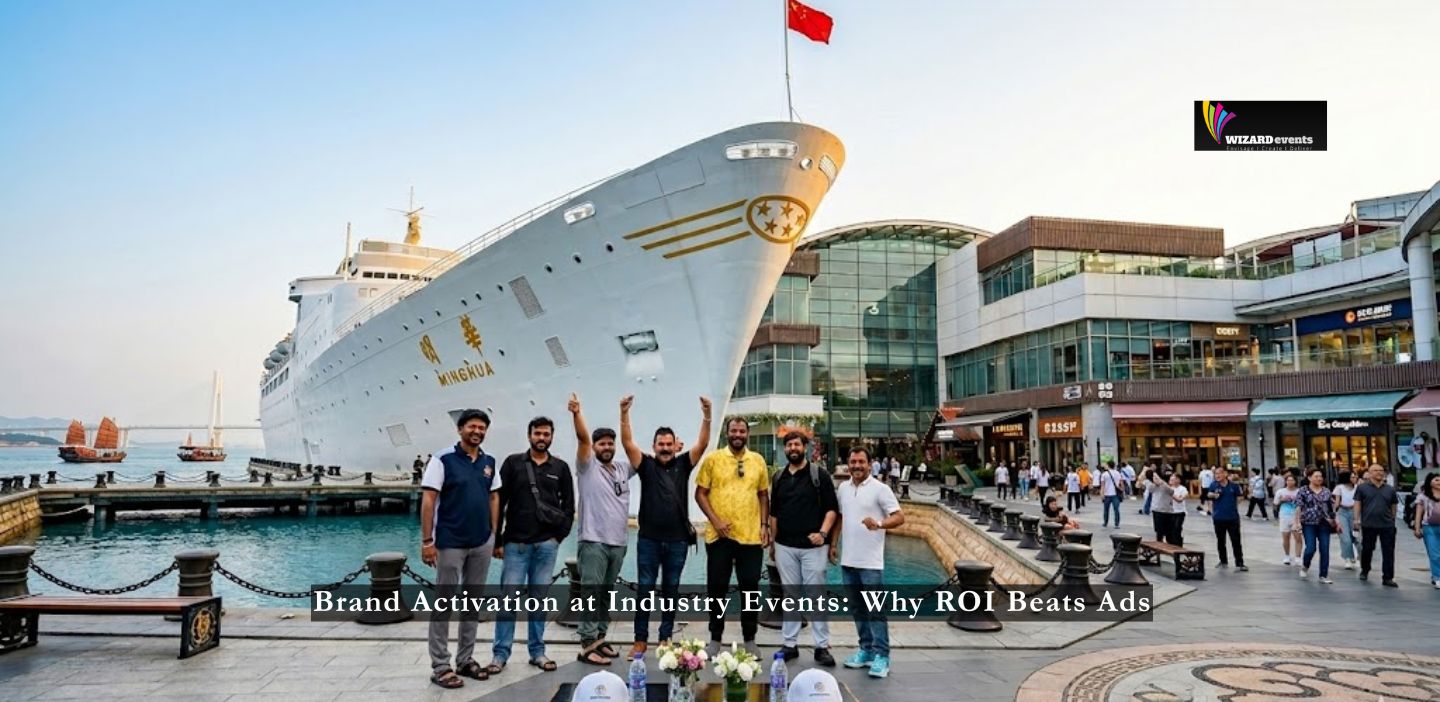
Real Execution: Wizard Events Brand Activation in China
Wizard Events brand activation execution in China -
This is precisely the kind of activation Wizard Events recently executed at an international industry event in China. The brief demanded more than a branded space — it required an immersive brand presence where audience engagement was experiential, brand interaction was designed for memory recall, and every touchpoint of the journey was intentional.
The result was exactly what industry-specific brand activation delivers when designed correctly: strong audience recall, deep brand engagement, and a presence that outlasted the event itself in the conversations it generated.
This level of execution does not happen by accident. It requires a partner that understands both the MICE event environment and the brand strategy behind the activation — and treats them as one brief, not two separate workstreams.
Key Elements of a High-Impact Brand Activation
What separates a forgettable booth from a brand activation that drives measurable ROI? These six elements — and whether they are treated as integrated design decisions or afterthoughts:
- Creative concept design — the activation idea must be rooted in the brand's core message and designed specifically for the industry audience attending. Generic creative produces generic results.
- Audience journey mapping — every touchpoint from entry to exit must be intentional. What does the audience see first? What do they interact with? What do they leave with? Each moment is a designed decision.
- On-ground experience engineering — physical space, lighting, sound, movement flow, and interaction design all shape how the audience feels inside the activation. This is where event management expertise becomes brand strategy.
- Engagement triggers in real time - Gamification, interactive exhibits, live demonstrations, and personalization features keep viewers interested beyond a cursory peek.
- Visual narrative - Before a single word is spoken, the activation must visually convey the brand message. Visual design is the main factor that causes physical activations to produce substantially higher brand favorability and purchase intent than digital display advertising.
- Hooks that evoke strong feelings - the scene that evokes strong emotions in the spectator. A personalized encounter, a surprise component, and a shared experience. This is the point at which a visitor becomes a brand evangelist.
Industry Use Cases: Where Brand Activation Works Best
9 out of 10 marketers consider brand experiences important to their business success — and across industries, the use cases for activation are expanding rapidly:
Corporate product launches — a product launch event in India designed around experiential activation creates stronger press coverage, social amplification, and dealer engagement than a press release and paid media campaign combined.
Global conferences and leadership summits — brand presence at a leadership summit positions your company as a peer of the industry's most influential voices, not just a sponsor logo on a banner.
Dealer meets and trade exhibitions — channel partners who experience a brand activation remember it in the room where buying decisions are made. The emotional association built at the activation carries into the commercial conversation.
Employee engagement events — internal brand activation through employee engagement programmes builds the same emotional equity internally that external activation builds with customers. Brand belief starts with the people who represent it.
The Shift Every Modern Brand Needs to Make
The marketing environment has undergone a lasting transformation. In the marketing services sector, experiential marketing now holds a 38% market share, outpacing digital advertising's 35%. Companies that continue to focus on impressions and reach are competing in a market that their most forward-thinking rivals have already surpassed.
The shift is from reach-based marketing to experience-based marketing. From buying attention to earning it. From being seen to being felt.
Conclusion: Experience Is the New Competitive Advantage
If you are planning a brand activation or a product launch event, visibility alone is no longer enough. The brands that win in industry-specific environments are the ones that design experiences with the precision of a strategy document and the creativity of a great story.
Wizard Events creates experiential brand moments that deliver measurable impact — from the concept brief to the last audience interaction. Whether you are activating at a domestic industry conference or an international MICE event, we build the experience that your audience remembers and your competitors wish they had thought of first.