13 Oct, 2026
24 Dec, 2025
The question leaders are asking today is no longer whether wellness matters.
It is how to create a wellness culture at work and improve employee well-being without turning it into another superficial initiative that fades within months.
Across industries, especially among organisations working with corporate event management companies in india, wellness has moved out of HR handbooks and into lived experience. Employees do not evaluate wellness by policies. They evaluate it by how work feels on a normal Tuesday.
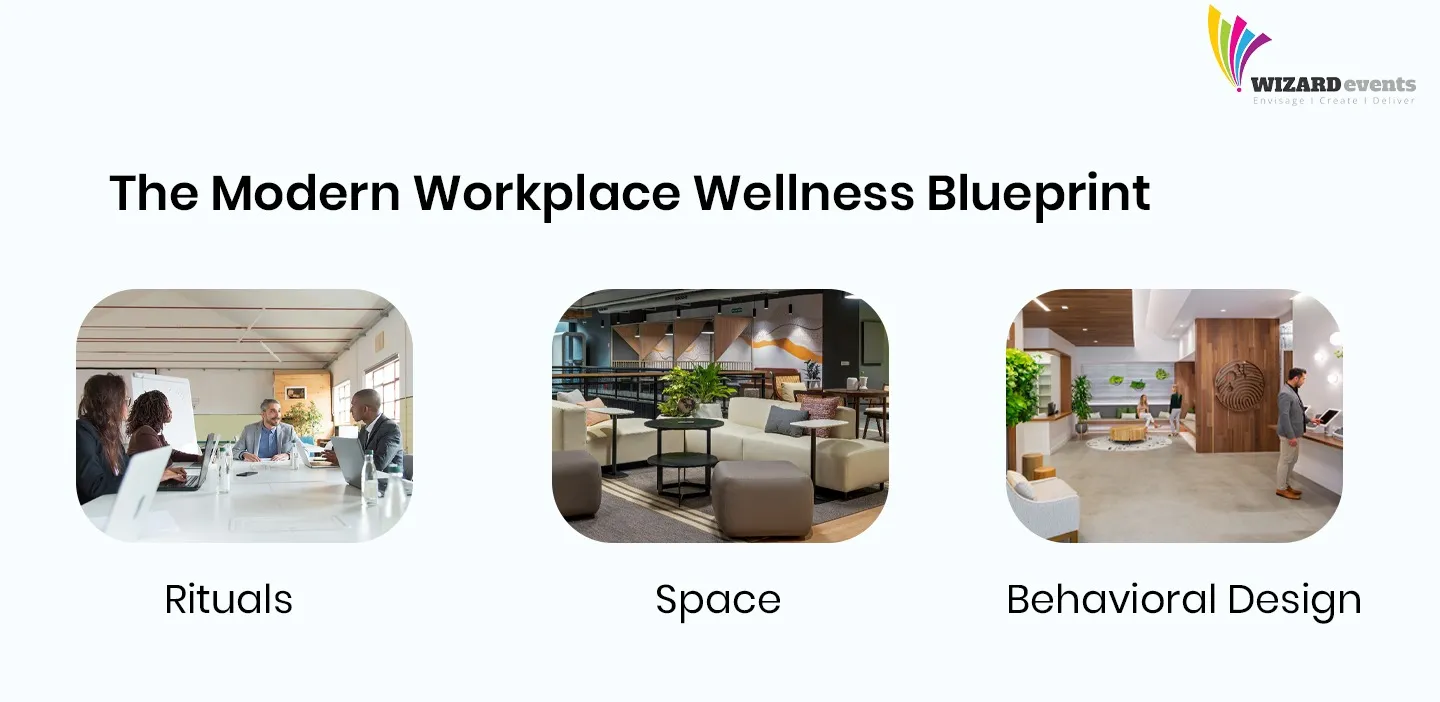
Wizard Events has worked inside this shift closely. What has become clear is this: sustainable wellness is not built through benefits alone. It is built through rituals, spatial design, and behavioural cues that shape how people experience work every day.
This blueprint draws from global research, workplace data, and on-ground execution insights to explain what actually works.
Wellness Is a System, Not a Program
Many organisations still approach wellness as an add-on. Meditation apps. Annual health days. Occasional offsites.
The problem is not intent. It is fragmentation.
According to World Health Organization, 62% of workplace stress-related outcomes are driven by organisational design rather than individual health choices
Source: WHO Mental Health at Work Report
Reference: https://www.who.int/teams/mental-health-and-substance-use/mental-health-at-work
This reframes the challenge entirely. Wellness is shaped by how work is structured, how decisions are made, and how people are expected to behave under pressure.
Wizard Events approaches wellness as infrastructure. If the system constantly creates urgency, no yoga session will counterbalance it.
Rituals Shape Psychological Safety
Rituals are often mistaken for culture. In reality, they are behaviour enforcers.
Daily stand-ups. Weekly reviews. Monthly townhalls. These moments teach employees what matters, what is rewarded, and what is ignored.
According to Harvard Business Review, 68% of employees associate psychological safety with consistent team rituals rather than leadership statements
Source: HBR Analytic Services, Psychological Safety Study
Reference: https://hbr.org/2023/01/what-psychological-safety-really-means
Wellness-focused organisations use rituals deliberately. They normalise recovery time. They reward boundary-setting. They allow reflection without penalty.
Wizard Events has designed internal forums where silence is permitted, questions are unscripted, and leaders model restraint. These rituals reduce stress not by instruction, but by permission.
Space Influences Behaviour More Than Messaging
Physical and digital spaces shape how people behave long before policies do.
According to International WELL Building Institute, 57% of employees report improved well-being when workplace spaces are designed to reduce cognitive overload
Source: IWBI WELL Concept Research
Reference: https://www.wellcertified.com/
Open plans that discourage privacy. Always-on digital channels. Overbooked calendars. These design choices silently erode wellness.
Modern wellness design focuses on choice. Spaces to collaborate. Spaces to pause. Spaces to disengage without justification.
Wizard Events integrates spatial design into experience planning. Offsites are structured to reduce sensory fatigue. Event flows include decompression time. Wellness emerges when space supports human rhythms.
Behavioral Design Is the Missing Layer
Most wellness initiatives fail because they rely on willpower.
Behavioral science shows that people follow defaults.
According to Behavioral Insights Team, 64% of employee behaviour is influenced by environmental cues rather than conscious intention
Source: BIT Workplace Behaviour Report
Reference: https://www.bi.team/publications/
Wellness improves when healthy behaviours are easier than unhealthy ones. Shorter meetings by default. Clear end times. Visible leadership disengagement after hours.
Wizard Events embeds these cues into event design. Schedules that respect energy cycles. Agendas that limit cognitive load. These signals shape behaviour without instruction.
Why Events Matter in Wellness Culture
Events act as behavioural amplifiers.
Employees pay attention during events. What leaders do in these moments carries disproportionate weight.
According to Gallup, 71% of employees say leadership behaviour during key organisational moments influences their sense of well-being more than everyday management
Source: Gallup State of the Global Workplace
Reference: https://www.gallup.com/workplace/349484/state-of-the-global-workplace.aspx
This is why organisations increasingly rely on corporate event management companies in india to design experiences that reinforce wellness norms rather than contradict them.
Wizard Events treats events as wellness signals. Overpacked agendas communicate urgency. Balanced pacing communicates respect. Employees read these cues instantly.
Wellness and the Employee Loyalty Program Connection
Wellness and retention are inseparable.
According to Deloitte, 61% of employees are more likely to remain with organisations that prioritise well-being through everyday practices rather than formal benefits
Source: Deloitte Global Human Capital Trends
Reference: https://www2.deloitte.com/global/en/pages/human-capital/articles/global-human-capital-trends.html
This is where the employee loyalty program conversation needs rethinking.
Loyalty does not grow from perks. It grows from how work feels consistently. Wellness-focused environments reduce burnout, increase trust, and strengthen commitment.
Wizard Events has seen organisations integrate wellness principles into recognition frameworks rather than separate programs. Loyalty improved because employees felt cared for, not managed.
Measuring Wellness Without Reducing It
Measurement remains tricky.
According to PwC, 58% of organisations struggle to measure wellness without oversimplifying it
Source: PwC Workforce Wellbeing Survey
Reference: https://www.pwc.com/
Leading organisations now track indirect indicators. Attrition patterns. Sick leave trends. Engagement stability.
Wizard Events encourages leaders to observe behaviour rather than chase scores. Are people leaving on time? Are conversations calmer? Are decisions clearer? These signals matter.
What High-Maturity Organisations Do Differently
Global benchmarks show consistent patterns among organisations with strong wellness cultures:
- Rituals reinforce boundaries
- Space allows recovery
- Leadership models restraint
- Events signal care, not urgency
- The employee loyalty program reflects lived experience, not incentives
According to McKinsey & Company, 55% of high-performing organisations treat wellness as a leadership responsibility rather than an HR initiative
Source: McKinsey Organizational Health Insights
Reference: https://www.mckinsey.com/capabilities/people-and-organizational-performance/our-insights
Wizard Events operates within this mindset. Wellness is not branded. It is built.
The Blueprint in Practice
Wellness culture is not created in workshops.
It is created in systems.
Rituals that allow recovery. Spaces that reduce overload. Behaviours that signal care. Events that reinforce balance rather than urgency.
Organisations working with corporate event management companies in india increasingly recognise this. Wellness is no longer optional. It is structural.
Wizard Events continues to build within this reality. Designing experiences where well-being is not promoted, but protected.
Because the modern workplace does not need more wellness slogans.
It needs better design.